Practical guide
Hair Product Cost per Use and Period-After-Opening Labels
Calculate purchase cost with compatible quantity units, then keep opening periods, printed dates and batch history in a separate record. A lower price per use does not establish whether a product remains suitable.
Compare a purchase you can actually use
A larger bottle can be cheaper per millilitre and still cost more per use if much of it remains unused. Compare the purchase price with the amount you expect to use within the product’s actual instructions and stated limits. Keep the money calculation separate from the decision about whether a product remains suitable to use.
This guide pairs a cost worksheet with a label-reading record. It does not rank brands or prescribe how much conditioner your hair needs. For application order, use the separate label-based routine worksheet. For date definitions first, see beauty product shelf life and opening dates.
Use the exact product and container you own. A manufacturer website can help clarify a question, but a related product name, another regional formula or a repacked sample is not automatically the same record.
Calculate cost per use with compatible units
Estimated equivalent uses = quantity used ÷ quantity per use. Then divide the purchase price by the equivalent uses. If all the pack is used, quantity used equals the pack quantity. If some is discarded or left unused, subtract that amount first. “Equivalent” allows a partial quantity in the arithmetic; it does not promise a number of complete applications.
Keep units consistent: 200 mL divided by 4 mL gives 50 equivalent uses. A 100 g jar divided by 2 g gives 50. Do not divide grams by millilitres or assume they are interchangeable. The quantities below are invented arithmetic inputs, not dose recommendations or measured averages.
| Purchase scenario | Price / quantity used | Observed or assumed amount | Equivalent uses | Purchase cost / use |
|---|---|---|---|---|
| Small hypothetical bottle | $9 / 200 mL | 4 mL | 50 | $0.18 |
| Large hypothetical bottle; all used | $15 / 400 mL | 4 mL | 100 | $0.15 |
| Same large bottle; 200 mL not used | $15 / 200 mL actually used | 4 mL | 50 | $0.30 |
| Hypothetical mask jar | $20 / 100 g | 2 g | 50 | $0.40 |
The large bottle’s theoretical $0.15 assumes all 400 mL are used. If only 200 mL are used, its full $15 purchase supports 50 uses, giving $0.30. Do not subtract the value of discarded product from the price: that expense was still paid.
For a finished pack, the clearest realized calculation is total purchase price divided by the actual number of completed uses you recorded. An estimate based on amount per use is less certain when application amounts vary or product remains in the container. Keep tax, discounts and delivery assumptions consistent across comparisons.
Try the calculator without making a product recommendation
Estimate equivalent uses and purchase cost per use
Use one currency and one quantity unit throughout. Values are your observations or assumptions, not recommended application amounts.
Choose Calculate to see the estimate.
No dates or personal care conclusions are calculated. Values stay on this page and are not submitted or saved.
Enter a measured observation or a clearly labelled planning assumption. The calculator subtracts the quantity not used, divides the remaining quantity by the amount per use and divides price by that result. Changing mL to g changes the unit label; it does not convert mass into volume.
A blank amount, zero quantity per use or unused quantity equal to the whole pack leaves the estimate unavailable. A free product may legitimately have a zero purchase price. That still says nothing about effectiveness or suitability. The tool calculates purchase cost only; it cannot establish contamination, shelf life or an appropriate application amount.
Garnier’s checked conditioner instructions use “quarter-size” with adjustment for hair length or thickness. That description is not a calibrated millilitre measure. We have not converted it into a dose or inserted it as a supposedly measured number.
Distinguish opening periods, dates and batch references
The open-jar symbol is used for period after opening. A label such as 12M means a twelve-month period after opening for that labelled product. The hourglass is associated with date of minimum durability. Both symbol categories were checked in Annex VII; its illustrated jar itself contains no period number, so our 12M drawing below is an example.
| Record type | What to look for | What to record |
|---|---|---|
| Period after opening | Open-jar symbol with a period such as 12M | Record first-opened date; follow the actual stated period and storage directions. |
| Minimum-durability date | A date, “best used before the end of,” or the associated symbol | Copy the actual date and any required storage conditions. |
| Batch / lot reference | An identifier such as a printed letter-number code | Keep it for manufacturer identification; do not assume it is a date you can decode. |
| Unopened shelf-life statement | Manufacturer’s statement for a named product | Check the stated starting point; do not automatically add years to purchase date. |
In the UK-version Article 19(1)(c), products with minimum durability greater than 30 months do not require the minimum-durability date; a period after opening is indicated unless that concept is not relevant. This is the UK legislation context. It is not a survey of every jurisdiction or a rule that every cosmetic container must display the same symbol.
FDA says U.S. cosmetics are not required to have specific shelf lives or expiration dates on labels. Manufacturers are still responsible for safety. FDA distinguishes drugs, including products that are both cosmetics and drugs, which require expiration dating. Do not apply a general cosmetic opening-period shortcut to a product regulated as a drug.
Keep opening period and printed date as separate fields. A reminder from opening does not cancel another applicable date or storage condition. If the information conflicts or cannot be identified, ask the manufacturer with the exact name, region and batch reference rather than using a third-party decoder as proof.
Read a manufacturer example within its limits
The checked Garnier U.S. Sleek & Shine Smoothing Conditioner page includes the FAQ “How Long Does Sleek & Shine Smoothing Conditioner Bottle Last?” Its answer calls the product Sleek & Shine Anti-Frizz Conditioner and states three years unopened and twelve months once opened. Keep that wording and page identity together; it is a manufacturer statement for the named product.
The answer does not specify whether the unopened period starts at manufacture or another point. It therefore does not justify adding three years to your purchase date. Nor does it establish the age of a particular batch. The physical label, lot reference and a manufacturer clarification may be needed.
We have not verified a PAO stamp on every bottle, a retailer’s current price, laboratory stability testing or the shelf life of another Garnier formula. Manufacturer benefit claims on that page are also outside this cost-and-label task. The cost examples remain hypothetical even though the duration example comes from a real page.
Keep one opening-date and cost record
View the label-and-cost route. Copy the product identity and label first, then make a cost estimate. A lower estimated price per use never grants permission to continue with a questionable product.
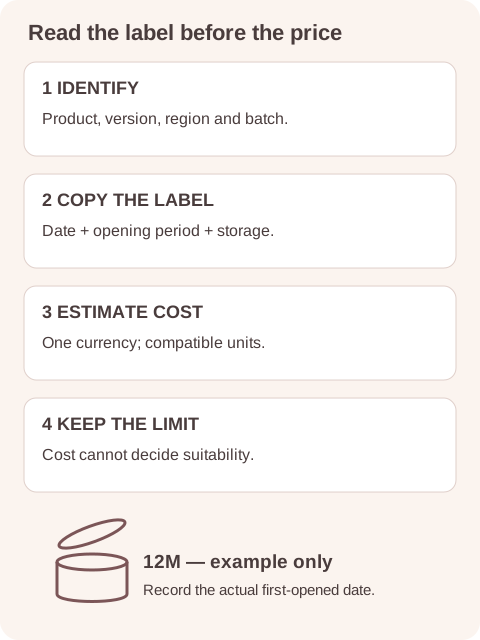
Download the opening-date and cost record, including formulas, examples and the eight case answers. Record the first-opened date when you actually open the product. For an already-opened bottle with an unknown date, write unknown; do not restart its history.
PRODUCT / VERSION / REGION:
BATCH OR LOT / LABEL SOURCE:
PURCHASE DATE:              FIRST OPENED:
PRINTED DATE:              OPENING PERIOD:
STORAGE INSTRUCTIONS / UNKNOWN HISTORY:
PRICE AND CURRENCY:        PACK QUANTITY AND UNIT:
QUANTITY PER USE:          UNUSED QUANTITY:
OBSERVED OR ASSUMED?        ACTUAL COMPLETED USES:
COST ESTIMATE:             QUESTION FOR THE MAKER:
FDA describes moisture, fingers or applicators, air, sunlight and temperature changes as factors that can affect cosmetics. Keep containers and applicators clean and follow storage instructions; avoid hot-car storage. A product that looks or smells normal is not automatically within its stated limit. Do not dilute or alter a formula to recover unused purchase value.
For the next purchase, compare a smaller pack, fewer duplicate products or waiting until an existing suitable product is finished. Do not speed up usage or expand application areas merely to meet an invented use-up target.
Eight cost and label checks with explanations
Use these original cases to separate arithmetic, the source’s actual wording and unknown product history. Open an explanation after writing your own answer.
Case 1
A $15 / 400 mL bottle costs less per mL than a $9 / 200 mL bottle. You use only 200 mL of the large bottle before it must be discarded. With 4 mL per recorded use, which has the lower purchase cost per use?
Show answer and explanation for case 1
The small bottle: $0.18 per use versus $0.30 for the large bottle.
Both supply 50 recorded uses in this example. Divide the full purchase price by those uses: 9/50 and 15/50. A lower package-unit price did not prevent unused product from raising the realized cost.
Case 2
A mask is labelled 100 g and a conditioner 250 mL. Can their pack quantities be compared directly as if a gram equals a millilitre?
Show answer and explanation for case 2
No. Keep the quantity and use amount in the same unit for each product.
Mass and volume are different quantities. A density or manufacturer-specific conversion would be needed to convert between them. You can compare resulting currency-per-use estimates after calculating each with its own compatible units.
Case 3
A hypothetical product’s actual label says 6M after opening. You first open it on 20 March 2026. Which date belongs in the six-month reminder?
Show answer and explanation for case 3
20 September 2026, subject to the actual product instructions and conditions.
The period is measured from opening, not purchase. This is a calendar illustration, not the verified period for a named product. A reminder does not override an earlier printed date, compromised storage or other reasons to stop use.
Case 4
A U.S. cosmetic has no printed expiration date. Does that mean it stays usable indefinitely?
Show answer and explanation for case 4
No. The absence of a mandatory cosmetic date is not unlimited shelf life.
FDA says U.S. cosmetics are not required to carry specific shelf lives or expiration dates, while manufacturers remain responsible for safety. Product type, use and storage still matter. Ask the maker about the named product instead of inventing a universal period.
Case 5
The checked Garnier FAQ says3 years unopened and12 months opened. Can you write “expires3 years after I bought it” on every bottle?
Show answer and explanation for case 5
No. The FAQ does not establish that purchase date is the unopened clock’s starting point.
Keep the statement tied to the named product. Consult the actual packaging and maker if the batch age or starting point is unclear. Do not extend that FAQ answer to another formula, brand, region or repacked container.
Case 6
A product is beyond its stated limit but still smells normal. Can smell alone renew that limit?
Show answer and explanation for case 6
No. Normal smell does not replace the label or establish safety.
FDA describes several ways cosmetics can change or become contaminated. Some problems are not settled by a casual smell check. Do not use a reassuring appearance to extend a stated period or date.
Case 7
A partly used bottle has an unreadable opening date and no dependable record. Should you choose today as a new opening date?
Show answer and explanation for case 7
No. Leave the date unknown rather than resetting the clock.
Save the available label and batch details and ask the manufacturer about the unresolved history. Adding a fresh reminder to an already-opened product would hide information instead of establishing a new safe period.
Case 8
You enter 200units purchased and 200units not used in the cost calculator. Should it report zero cost per use?
Show answer and explanation for case 8
No. There is no positive used quantity to divide into uses.
The estimate must remain unavailable. Zero completed use does not erase the purchase expense, and division by zero does not produce a meaningful per-use price. Record the unused purchase separately.
Make the purchase decision without moving the label boundary
A useful comparison can say “the larger pack is cheaper only if I use enough of it” without making any judgment about product quality. Keep the estimated number of uses, actual completed-use record and remaining uncertainty visible. A different frequency or amount per use can change the money result.
A useful label conclusion identifies the exact period or date and its source. If batch age, opening date or storage history remains unclear, the calculation cannot resolve it. Ask the maker a concrete question with the available details. A bargain, attractive label or normal smell cannot reset the product’s history.
Choose a pack that fits the routine you actually have. Buying fewer duplicates may reduce unused expense, but this worksheet does not prove an environmental benefit or rank packaging systems. Its result is a traceable purchase estimate and a separate product-label record.
Sources and further reading
- FDA: Shelf Life and Expiration Dating of CosmeticsShelf life varies with product, use and storage; contamination and heat can shorten it. U.S. cosmetic-label requirements differ from drug expiration requirements. FDA page dated 25 February 2022.
- Legislation.gov.uk: Article 19, cosmetic labelling — UK versionArticle 19(1)(c) distinguishes minimum durability and period after opening for products with durability over 30 months, with an exception where after-opening durability is not relevant. UK-version context, not a current EU-wide legal survey.
- Legislation.gov.uk: Annex VII packaging symbols — UK versionRendered Annex VII and images visually checked: open jar for period after opening, hourglass for minimum durability. The source jar has no number; our 12M example is illustrative.
- Garnier U.S.: Sleek & Shine Smoothing ConditionerActual FAQ says 3 years unopened and 12 months opened for the named conditioner. It does not specify the unopened clock’s start in that answer. Its quarter-size amount is not converted to a measured volume; retail prices, efficacy and every physical bottle were not verified.