Practical guide
Hair Product Order: A Routine Worksheet Based on Label Directions
Copy each product’s exact preparation, removal and next-step requirements. Build only the route you need, and use morning/evening records without inventing application frequency.
Make one label record for each product and each use mode
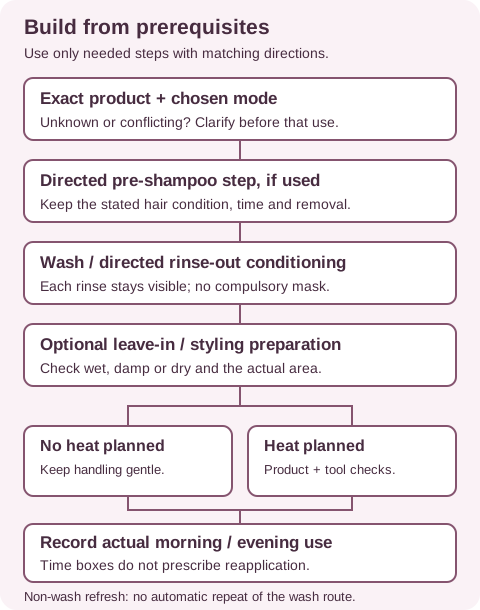
Hair product order starts with the directions on the exact product you own. Identify anything used before shampoo, anything that must be rinsed out, the hair condition required for a leave-in, and the preparation your styling tool requires. Then place only the steps you actually need in that sequence.
A short wash routine might include shampoo, rinse-out conditioning, gentle water removal and optional styling. A pre-shampoo treatment adds a step before cleansing only when its own directions call for one. A non-wash morning may need no new product at all. There is no label-based reason to apply every item twice because a planner has morning and evening spaces.
Put the packages beside the worksheet before deciding on order. Record one chosen use at a time. A product with both rinse-off and leave-in directions needs two distinguishable records if you are comparing those possibilities; it does not automatically need two applications in one routine.
| Field | What to copy | What not to infer |
|---|---|---|
| Exact identity | Product name, version, market and current package. | A familiar brand or number can cover different formulas. |
| Chosen use mode | Rinse-off, leave-in, pre-shampoo or another explicitly stated use. | A multi-use name does not tell you to perform all its modes. |
| Starting hair condition | Wet, damp, towel-dried or dry, in the product’s words. | These words are not interchangeable just because hair feels manageable. |
| Application area | Scalp, roots, lengths or ends as directed. | A hair product is not automatically intended for scalp symptoms. |
| Amount and waiting time | Copy the actual instruction; keep estimates labeled. | No instruction is not permission to borrow a timer from another product. |
| Removal | Rinse, wash afterward, or an explicit leave-in use. | Using less does not convert rinse-out into leave-in. |
| Next-step requirement | What must happen before another product or a styling tool. | A product’s preparation instruction does not override the tool’s instructions. |
| Frequency and unresolved issues | Record stated frequency and any conflicting wording. | Morning/evening boxes are a diary, not a twice-daily prescription. |
Use the matching current package and manufacturer guidance for your market. A retailer title, a remembered routine and a product-family chart may omit the condition that determines the next step. If the package and matching guidance still conflict, keep the question unresolved and ask the manufacturer before that use.
Four direction records show why category names cannot decide order
These are manufacturer webpages checked on 31 October 2026, UTC, not photographs of bottles or firsthand product tests. The records demonstrate how to sort instructions. They are not a recommended combined routine or a comparison of product performance.
| Product and mode | Starting condition and area | Wait, removal and next step | Boundary |
|---|---|---|---|
| OLAPLEX N°.3PLUS Complete Repair Treatment, current U.S. page | Wet hair, generously from roots to ends. | 3 minutes, rinse, then follow with OLAPLEX shampoo and conditioner. | A pre-shampoo branch for this version; not a timer for older N°.3 or every treatment. |
| L’Oréal Paris Elvive Total Repair 5 Repairing Conditioner, U.S. page | After the page’s shampoo step; mid-lengths and ends. | 1–2 minutes, then rinse. | Its family routine includes other products; that does not make every step necessary for every reader. |
| Elvive Total Repair 5 Power Restore Multi-Use Treatment: rinse-off mode | Wet hair; the page describes conditioning or co-washing. | 1 minute, then rinse. | The conditioner’s related-product routine instead says 3–5 minutes; keep that conflict visible. |
| The same Power Restore product: leave-in mode | Dry or wet hair. | Apply and style as usual, in the separate leave-in directions. | This is a permitted mode of this product, not permission to leave any conditioner or mask on. |
The current N°.3PLUS page places its three-minute application before shampoo and conditioner. Its FAQ also recommends using it before shampoo and following bottle directions rather than making an overnight use. We have not established that an older N°.3 bottle has these directions: the PLUS version is part of the identity, not decoration.
Power Restore’s own page gives different removal instructions for its two modes. Choose the intended mode before putting it on a planner. Do not turn “multi-use” into a rule that you must co-wash, rinse-off and leave-in during the same session.
The manufacturer pages also make repair and strength claims. A use direction tells you where a product belongs; it does not independently establish that it outperforms your present routine, treats a scalp condition or will produce a particular result. The mask-versus-conditioner guide addresses those claim-reading questions separately.
Build the route around removal and the next step’s prerequisites
Start by deciding whether this is a wash session or a non-wash refresh. That decision follows your scalp, hair and actual needs, rather than the number of products available. AAD’s healthy-hair guidance recommends washing according to how dirty or oily hair becomes and choosing products for your hair type.
- Place a directed pre-shampoo step first, if you are using one. Preserve its starting hair condition, area, timer and removal. “Pre-shampoo” describes a relationship to cleansing; it does not mean every such product goes on dry hair.
- Keep cleansing and removal explicit. Write the shampoo and its rinse as separate actions when that prevents confusion. AAD advises concentrating shampoo on the scalp rather than aggressively washing the whole length.
- Place rinse-out conditioning where its directions put it. Keep the actual timer and rinse. Whether another treatment replaces or follows conditioner depends on the matching directions, not on the word “mask.”
- Check the starting condition for any leave-in or styling product. Wet, damp and dry directions can place products at different stages. Record the application area and amount instead of assuming every leave-in belongs at the roots.
- Check the next tool or drying step before proceeding. Read its permitted hair condition, heat instructions and compatibility with the product used. A spray allowing damp-hair application does not authorize using every hot tool on damp hair.
This is a way to organize dependencies, not one mandatory five-step routine. Skip products without a useful job, and do not add an unspecified waiting period between every leave-in. If two products require different starting conditions, prepare the hair appropriately for each intended use or choose a simpler route while clarifying the combination.
AAD recommends conditioner after washing, with the ends emphasized for fine or straight hair and the lengths for dry or curly hair. That general conditioning advice does not overwrite the roots-to-ends instruction of the particular pre-shampoo example. Keep general hair care and the chosen product’s role distinguishable.
For heat styling, AAD recommends limiting heat, using low or medium settings and a heat-protective product. An oil, a shine claim or a comfortable-feeling cream is not by itself evidence of heat protection. This worksheet does not certify a combination or choose a temperature. The temperature conversion guide helps compare a confirmed reading in different units.
Use morning and evening spaces to record events, not prescribe frequency
Morning and evening identify when something happened. They do not supply an application schedule. A wash can occur in either space, and a non-wash day can have no product entries. Keep the plan separate from the actual record so an intended step does not become a claim that you completed it.
| Moment | Plan only what is needed and directed | Record the boundary |
|---|---|---|
| Morning wash | Which directed steps are needed; each rinse and next prerequisite. | Which products and modes you actually used; any departure or unknown. |
| Morning without washing | No product, or a specifically permitted refresh use if needed. | A refresh is not evidence that yesterday’s protection or product claim carries forward. |
| Evening wash | A separately planned wash route, if washing is needed then. | An evening time does not authorize longer exposure or an overnight rinse-out use. |
| Evening without washing | Leave the box empty or write “no product” when that fits. | Do not add a second application merely to fill the diary. |
If you applied a leave-in yesterday, do not assume the next morning requires another dose, or that it is ready for a new heat-styling session without checking directions. Read the product and tool requirements for the intended next use. A calendar tick is not proof of continuing heat protection.
The N°.3PLUS page gives several frequency descriptions: its main instructions say every 1–3 washes with daily use possible, while FAQs discuss once or twice weekly and weekly use. Those statements do not choose a wash schedule for every hair type. Keep the actual bottle wording and ask if you need clarification; do not average different wording into a new rule.
When noting the result, use ordinary observations: “the ends felt coated,” “detangling was easier,” or “I noticed itching.” Record other changes such as a new shampoo, different amount or a different drying method. A one-person diary cannot isolate the cause or measure repair percentage, even if the before-and-after rows look tidy.
Four fictional plans show what a finished record can leave out
These original invented plans illustrate records, not reader testimonials, product tests or recommended routines to copy. Use the structure with your own matching directions and needs.
1. A wash morning with a known rinse boundary
Mara plans her usual shampoo and a conditioner with a clear rinse-out instruction. She copies its timer, writes “rinse,” and leaves the styling-product box empty because she is not using one.
The route is complete without a mask, oil or evening application. The fictional record establishes no result or personal suitability.
2. A treatment that belongs before shampoo
Leon’s current bottle matches the N°.3PLUS example. He places its directed wet-hair application, three-minute wait and rinse before the named shampoo-and-conditioner steps.
He does not move it after conditioner because a generic chart lists “treatment” there. He does not extend the timer to overnight.
3. A jar with more than one possible use
Priya records Power Restore’s rinse-off mode in one row and its separate leave-in mode in another while deciding what job she needs. The family page’s timer conflict goes in a question box.
The two rows are alternatives under review, not a direction to perform both. She clarifies the unresolved rinse-off instruction instead of inventing a midpoint.
4. A non-wash evening that needs no new layer
Sam’s evening plan says “no product.” He records that he did not wash, apply another styling layer or use heat. A later wash has its own entry.
An empty product row is useful information. It does not indicate a missed routine, and no outcome is promised by keeping the routine short.
If a needed instruction is absent, the plan can end at “check before use.” A complete-looking sequence is less useful than an honest incomplete one when the next step depends on information you do not have.
Keep missing directions, conflicts and discomfort out of the routine test
When directions disagree, first check product identity, market, version and chosen mode. A family routine might describe a related product, or a newer product may share an old name. If those checks do not resolve it, keep the actual statements and sources together and ask the manufacturer. Do not average timers or automatically choose the longest exposure.
The reviewed Elvive conditioner page places its own rinse-out conditioner after shampoo for 1–2 minutes. Its later family step gives either named mask 3–5 minutes, while Power Restore’s dedicated rinse-off instructions say one minute. This is a real difference in the checked text. We have not obtained a manufacturer explanation or declared one webpage the newest package.
Do not infer compatibility by mixing products in your palm because a chart lists them beside each other. The order of separate applications is different from mixing formulas. If the planned combination or a medicated scalp product is unclear, get appropriate product or professional advice rather than overriding instructions with a cosmetic sequence.
If a product causes burning, a rash or obvious irritation, stop the suspected product and seek appropriate advice for significant or persistent symptoms. Do not keep using it just to finish the morning/evening diary or test whether a different position in the order fixes it. Hair feel, unexplained shedding and persistent scalp symptoms are different questions; AAD recommends working with a dermatologist for hair and scalp conditions.
Check gentle handling as well as product order. AAD advises careful detangling from the ends upward and absorbing water with a towel or T-shirt rather than rough rubbing. Its detangling advice differs for thick curly and straight hair. A universal wet-or-dry combing rule would lose that context. The basic routine guide keeps those broader considerations together.
Download the label inventory and separate morning/evening record
Download the editable product-order worksheet. It includes one-product records, the routine diary, direction examples, four fictional plans and six questions with separate answer notes. Copy the diary for a morning or evening event only when you need an entry.
ONE PRODUCT / ONE CHOSEN USE MODE
Exact name, version and market:
Current package or manufacturer source; date checked:
The job I need this step to do:
Chosen mode; alternatives kept separate:
Starting hair condition, copied exactly:
Application area and amount as directed:
Wait, rinse or explicitly leave in:
Required next step; tool prerequisites if relevant:
Frequency wording, if given:
Missing or conflicting directions to clarify before use:
Place in my intended route, or omit/check first:
MORNING / EVENING ROUTINE RECORD — NOT A FREQUENCY RULE
Date and actual session time:
Morning / evening; wash / non-wash:
Planned route, including each rinse and prerequisite:
Products and chosen modes actually used, in order:
Amounts, starting hair condition and areas actually used:
Rinsing or other removal actually completed:
Heat or drying method; instructions checked:
Any departure, estimate or unknown:
Scalp and lengths afterward, in plain words:
Other changes; cause not established:
Next session: keep / omit / clarify; no automatic reapplication:
Keep an original package or suitable source reference with the record so a shortened row does not lose a warning. “No product” and “not yet clarified” are valid entries. The worksheet does not score product safety, verify a package, diagnose symptoms or prove that a routine works.
Six checks before turning a label record into an order rule
These original cases test instruction reading. They do not test products, choose a routine for an individual or establish an exposure as safe.
Case 1
A chart puts every “treatment” after conditioner. Your current N°.3PLUS directions say wet hair, three minutes, rinse, then shampoo and conditioner. Which route belongs on the record?
Show answer and explanation for case 1
Keep the directed pre-shampoo route for that exact product.
A broad category chart does not override preparation, removal and next-step requirements. The current PLUS version is not a label for every treatment.
Case 2
A jar has rinse-off and leave-in modes. Does “multi-use” require both in the same session?
Show answer and explanation for case 2
No. Identify the chosen mode and keep the alternatives separate.
Each mode has its own starting condition and removal. Multiple available uses do not establish that simultaneous or repeated use is needed or compatible.
Case 3
Your diary has an evening product box. Does filling it mean you should apply the morning product again?
Show answer and explanation for case 3
No. The box records an event; it does not prescribe another application.
A non-wash evening can say no product. Frequency and next-use requirements come from the matching directions and actual need, not the layout of the diary.
Case 4
Your hair oil makes the lengths feel shiny. Can that alone count as confirmed heat protection before any tool?
Show answer and explanation for case 4
No. Check an actual heat-protection instruction and the tool requirements.
Feel and shine are not a heat-protection claim or a compatibility test. Damp-hair product directions do not authorize a tool use that requires another hair condition.
Case 5
An older bottle says N°.3 without PLUS. Can this guide’s three-minute N°.3PLUS example replace its directions?
Show answer and explanation for case 5
No. Verify the exact version and matching current instructions.
The live product example is N°.3PLUS. We have not verified an older bottle’s timer or established that similarly numbered versions have interchangeable directions.
Case 6
Power Restore’s own rinse-off page says one minute, but a related family routine says 3–5. Is a two-minute average a verified resolution?
Show answer and explanation for case 6
No. Preserve the conflict and clarify the matching instruction.
An invented average has no source. Check the exact package, market and mode, and ask the manufacturer if the difference remains before that use.
Sources and further reading
- AAD: Healthy hair care tips from dermatologists (updated 12 August 2024)Complete guidance read: washing by need, conditioning placement, gentle handling, limited heat and professional hair/scalp care. AAD reviewers do not review this guide.
- OLAPLEX U.S.: N°.3PLUS Complete Repair TreatmentComplete current page read: wet roots-to-ends, three minutes, rinse, then named shampoo/conditioner. Keep PLUS identity and differing frequency wording; no independent efficacy or old-version claim.
- L’Oréal Paris U.S.: Elvive Total Repair 5 Repairing ConditionerComplete page read: own after-shampoo 1–2-minute rinse-out instructions and related-mask 3–5-minute family step, preserved as a conflict for Power Restore.
- L’Oréal Paris U.S.: Power Restore Multi-Use TreatmentComplete page read: one-minute wet-hair rinse-off use and separate wet/dry leave-in mode. No compulsory dual use or formula-mixing permission.