Practical guide
Cleaning Product Residue from Hairbrushes and Combs
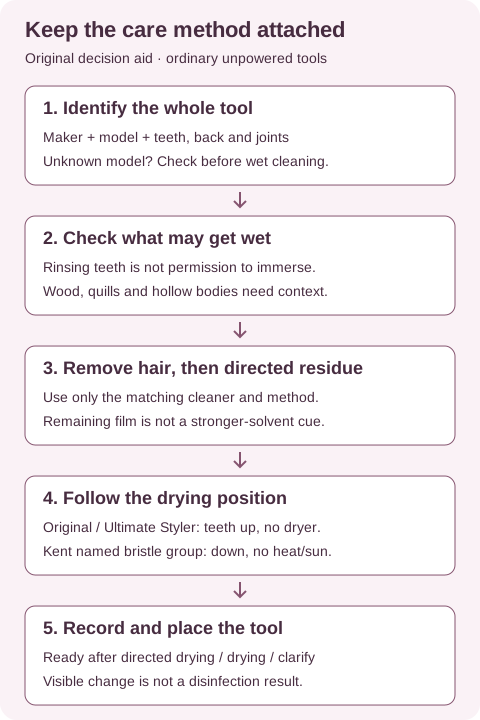
Identify the whole tool before water or cleaner. Keep the maker’s wet-method permissions, construction and drying position together; the named examples differ. Use the twelve-field record to describe actual cleaning and unresolved residue without claiming disinfection or a scalp treatment.
Before using water, identify the whole brush or comb
To clean product residue from a hairbrush or comb, remove loose hair first, identify the maker and model, and use its matching cleaning directions. Check the back, handle, cushion and joints as well as the teeth. A brush with washable-looking teeth can still have a part that must not get wet.
Do not begin with a bowl of cleaning solution and then decide which tools belong in it. Put aside powered styling appliances, tools with damaged teeth or loose parts, and anything whose water instructions you cannot confirm. This guide concerns ordinary unpowered hairbrushes and combs, not appliance maintenance, salon disinfection or treatment for head lice.
Describe what you see: loose hair, a sticky coating between teeth, a film on the base or an unknown mark. Appearance alone cannot tell you whether material is styling product, oil, skin flakes or something else. A cleaning record can describe a visible change without identifying its chemistry or proving that microbes have been removed.
Find the current package, care leaflet or manufacturer page for the item you own. Record a model number when available. “Plastic brush,” “wooden comb” and “boar bristle” are useful observations, but none supplies the whole cleaning method. Coatings, cushions and mixed materials can change the instructions.
Compare the maker instructions without turning them into one recipe
The following records come from the checked manufacturer webpages, not tests of purchased tools. Use them to understand the differences and find the instructions for your own item. The named examples are not a ranking or a shopping list.
| Item or category | What is identified | What the source says to do | Water and drying boundary |
|---|---|---|---|
| Tangle Teezer Original and Ultimate Styler | Named teeth-and-base tools in the cleaning article. | Remove loose hair; gently brush between teeth with a clean toothbrush dipped in warm soapy water. | Air dry teeth upwards; no hairdryer for these models. The FAQ also instructs rinsing. |
| Kent named bristle-brush families with a wood part | Aftercare explicitly says water must not reach the wood. | Remove loose hair; use lukewarm water with a little shampoo or mild detergent at the bristle tips only. | Do not submerge the brush or wet the wood; dry bristle down, away from heat and direct sun. |
| Kent Quill Brushes | Separate quill-brush section, not a universal material label. | Remove loose hair, then wipe individual quills with a cloth. | Do not submerge; allow to dry away from heat and direct sun. |
| Kent Handmade A OT pocket comb | Visible product heading and SKU A OT; cellulose acetate sheets. | Linked Handmade Combs instructions: wipe with a cloth; gently clean each tooth with a soft toothbrush. | Allow to dry; no heat source or direct sun. Wet-hair use is not a soaking instruction. |
| Kent Pure Flow LPF7 comb | Product page explicitly identifies natural wood. | Its care link goes to general aftercare; the checked text does not name an LPF7 comb method. | Keep the method unresolved and check matching instructions. Do not borrow the bristle-dipping method. |
Kent’s aftercare page groups several bristle-brush families together, including Handmade, Bristle, Gold Pin, Classic Shine, Pure Flow, Perfect For and Beard Brushes. It also provides a separate Quill Brushes section. If your brush could fit overlapping labels, check its actual care leaflet or ask for the model-specific method rather than choosing whichever section allows more water.
The A OT comb’s visible heading, SKU and material description identify the example used here. Its browser-document title includes a case-and-nail-file variant, so the title alone is not treated as the product identity. The LPF7 page confirms wood, but a general care link does not settle every detail of cleaning that comb.
Remove trapped hair, then use only the directed residue method
Loose hair can cover the base and make residue hard to reach. The checked Tangle Teezer and Kent instructions both start with removing hair. Work on the unpowered tool away from your head; do not pull it through hair to clear material caught in the brush.
Tangle Teezer’s guide says a pin-tail comb end may help lift loose hair from its Original and Ultimate Styler. Its round-brush section describes carefully snipping wrapped hair without damaging the brush. These are different model instructions. Do not turn the round-brush example into a reason to cut around every cushion or delicate bristle tuft.
For the Original and Ultimate Styler, the manufacturer describes warm soapy water and a clean toothbrush dipped into it, followed by gentle cleaning between the teeth and at the base. Its general FAQ additionally says to rinse and air dry teeth facing up. Neither passage supplies a fixed soaking time, disinfectant concentration or universal number of cleaning cycles.
For Kent’s named bristle-brush group, the water must not reach the wood, and the brush must not be submerged. The directed wet cleaning concerns the bristle tips. Its separate quill-brush method uses a cloth on individual quills. A coating that remains after the permitted method is a question to clarify, not permission to flood the cushion, scrape the base or switch to a stronger chemical.
The Handmade Combs section says to wipe with a cloth and use a soft toothbrush gently on each tooth for oil or dirt. Keep that method attached to the matching comb. Avoid forcing a cleaning implement into a narrow gap or treating an unfamiliar material as equivalent to the A OT example.
Use the cleaner named or permitted by the matching care instructions. This article does not establish that vinegar, alcohol, bleach, boiling water, a dishwasher or an overnight soak is compatible with your brush. A household ingredient’s familiar name does not answer a manufacturer’s material or finish requirements.
When soaking is prohibited or has not been established
Permission to use a tool on wet hair, permission to rinse its teeth and permission to immerse it are three different statements. Only a matching immersion instruction establishes that particular cleaning step. A hollow-looking plastic shell or a natural-looking finish is not enough.
| Situation | What the checked guidance establishes | Next decision |
|---|---|---|
| Wood or a wood-backed brush | Kent explicitly requires keeping water away from wood in its named bristle group. | Do not submerge or assume a wet-teeth instruction protects the back. |
| Quill brush or mixed construction | The quill section has a wiping method; category names can overlap. | Clarify the actual model rather than selecting a more aggressive wet method. |
| Hollow body or water inside a Tangle Teezer | The maker says not to open a Tangle Teezer or compact; opening could break it. | Contact the maker about retained water instead of prying it apart. |
| Powered appliance or unknown model | Ordinary brush directions do not specify its electrical cleaning method. | Use its own manual; keep it outside this brush-cleaning task. |
| Loose, damaged or hard-to-clean parts | Visible condition or unresolved residue changes the task. | Put it aside and clarify repair or replacement; do not invent a solvent or force test. |
The LPF7 wooden-comb example is especially useful for learning this distinction. We know its stated material. We do not have a separately named LPF7 cleaning procedure in the linked general text. The honest record says “method not yet confirmed,” rather than treating missing detail as approval.
Do not add a soaking duration because a calendar reminder needs a number. The reviewed sources do not establish one interval, solution concentration or immersion time for all hairbrushes and combs. Keep any instruction from your own matching leaflet in its exact context.
Dry by the matching directions before returning the tool to storage
Drying direction is part of the cleaning method. Tangle Teezer’s Original and Ultimate Styler instructions say teeth upwards and no hairdryer. Kent’s named bristle-brush group says bristles down on a level surface, with natural drying and no heat source or direct sunlight. These directions should remain separate.
Tangle Teezer’s guide gives different drying options for other named tools, including its Blow-Drying Tool. That exception does not allow a hairdryer on the Original or Ultimate Styler. Do not reason backward from a styling brush’s heat use to the cleaning permissions of a different brush.
After following the permitted method, check the accessible teeth, base and handle in ordinary light. Record whether visible residue remains and whether parts feel loose or appear changed. An apparently clean surface cannot verify that a hollow interior is dry. The maker’s instruction not to open a Tangle Teezer remains relevant if water is inside.
Keep a drying item outside its closed storage space until its directed drying is complete. Make a small place for tools awaiting clarification so they do not return to the ready-to-use group by habit. The hair-tool drawer guide separates ready tools, drying tools and unresolved items without requiring new organizers.
A tidy drawer is an organizational result, not a cleanliness certification. This record does not measure drying time, bacterial counts, material damage or a product’s lifespan. Note what you actually checked and what remains inaccessible.
Four fictional records show what a useful conclusion can say
These original invented situations illustrate instruction reading. They are not reader testimonials, product tests or measured results. Use their structure to keep a cleaning action separate from a conclusion about health or durability.
| Situation | Recorded action or uncertainty | Bounded conclusion |
|---|---|---|
| Original-style brush with visible styling film | Ari confirms that the tool matches the maker’s named Original instructions, removes loose hair and records the directed toothbrush cleaning. | The record says teeth-up natural drying; no invented immersion timer or hairdryer step. |
| Wood-backed bristle brush | Jo finds the matching Kent bristle-family instructions and notes that the wood must remain out of the water. | Visible residue still at the base becomes a manufacturer question, not a reason to soak the back. |
| Wooden comb with general care link | Nia identifies LPF7 and its stated natural wood, but cannot confirm an LPF7-specific cleaning method in the general page. | The tool stays in the clarify group. An unfinished record is more useful than a made-up wet method. |
| Brush looks cleaner but scalp still itches | Em records less visible film after the permitted cleaning, while the scalp concern continues. | The observation does not prove residue caused the symptom or that another cleaning cycle will treat it. |
Cleaning visible residue is separate from diagnosing an itchy, painful or persistently flaky scalp. The American Academy of Dermatology’s healthy-hair guidance recommends working with a dermatologist for hair and scalp conditions. Its hair-washing and gentle-handling guidance is not a brush-disinfection protocol.
If you notice irritation or significant symptoms, stop the suspected irritating use and seek appropriate advice. Do not repeatedly use a rough or damaged tool to test whether cleaning fixed the problem. Unexplained shedding or persistent scalp changes need their own assessment rather than a stronger cleaning solution.
For product layers on the hair itself, use the product-buildup guide. For the order and removal of cosmetic products, use the label-based product-order worksheet. Neither topic is settled by finding residue on a comb.
Download a cleaning record that keeps missing instructions visible
Download the editable hairbrush and comb cleaning record. It includes twelve fields, the care comparison, four fictional records and six questions with separate answers. Keep your matching care leaflet or source beside it.
Fill in the tool identity before the cleaning action. Record “unconfirmed” when you cannot identify a part or permission. “No soaking instruction found” describes your check; it does not claim that every possible leaflet has been searched.
HAIRBRUSH / COMB RESIDUE CLEANING RECORD
Original organizational aid, not a disinfection log, material test or scalp diagnosis.

1. Date; maker, exact model and identifying package:


2. Materials and construction actually identified; unknown parts:


3. Matching care source or leaflet and date checked:


4. Visible residue before cleaning, in ordinary words:


5. Loose-hair removal method permitted for this tool:


6. Cleaner and water conditions stated by the maker:


7. Parts allowed to get wet; immersion permitted, prohibited or unconfirmed:


8. Directed cleaning and rinsing actually completed; departures noted:


9. Directed drying position and heat restrictions:


10. Accessible condition afterward; residue or retained water unresolved:


11. Storage decision: ready after directed drying / drying / clarify or repair:


12. Question for the maker; separate scalp concern if relevant:
Six checks before turning a care example into a cleaning rule
Try these instruction-reading cases before expanding the answers. They test the boundaries of the examples, not the safety or performance of a product you own.
Case 1
A wooden-backed bristle brush and a Tangle Teezer are beside the sink. Can one bowl-soaking recipe cover both?
Show answer and explanation for case 1
No. Keep each matching cleaning method separate.
Kent’s named bristle group prohibits submerging and wetting the wood. Tangle Teezer’s directed toothbrush method does not create a universal immersion rule.
Case 2
A guide allows low-heat drying for a named Blow-Drying Tool. Does that authorize a hairdryer on the Original?
Show answer and explanation for case 2
No. The Original instructions specify natural drying and no hairdryer.
Permissions stay with the named model. A different tool’s exception cannot replace that restriction.
Case 3
A comb page says suitable for wet hair. Is that a verified overnight soaking instruction?
Show answer and explanation for case 3
No. Wet-hair use does not establish immersion or a soaking duration.
Read the actual care method. The Kent Handmade Combs section describes wiping and gentle tooth cleaning, not an overnight recipe.
Case 4
You identify LPF7 as natural wood, but the general care page does not name its comb method. What should the record say?
Show answer and explanation for case 4
The model and material are known; the cleaning method remains unconfirmed.
Do not apply a brush-bristle dipping instruction to a wooden comb. Clarify the matching method before adding a wet cleaning step.
Case 5
A hollow Tangle Teezer seems to contain water. Should you pry it open to finish the record?
Show answer and explanation for case 5
No. The manufacturer advises against opening it and directs readers to contact it about retained water.
An inaccessible interior remains an uncertainty. A tidy record is not a reason to risk breaking the brush.
Case 6
The teeth look clearer after cleaning, but itching continues. Has the record proved a scalp treatment worked?
Show answer and explanation for case 6
No. Less visible residue is an observation about the tool, not a diagnosis or treatment result.
Persistent or significant scalp concerns need appropriate advice. Do not increase cleaning chemicals or force to test a health theory.
Sources and further reading
- Tangle Teezer U.S.: FAQs — cleaning and heat restrictionsComplete current FAQ text read. Warm soap, gentle toothbrush cleaning, rinse, teeth-up natural drying and range-specific heat limits; no universal soak.
- AAD: Healthy hair care tips from dermatologistsComplete current guidance read. Gentle handling and dermatologist context; not a brush-cleaning or disinfection protocol, and its reviewers have not reviewed this article.
- Kent: Product AftercareComplete current aftercare text read. Wood exclusions, separate bristle/quill/handmade-comb methods and heat/sun limits retained.
- Tangle Teezer U.S.: How to Clean your Tangle Teezer ProductsComplete current cleaning article read. Named model differences, no hairdryer for Original/Ultimate Styler and no opening a hollow brush. Health and lifespan marketing claims not adopted as proven outcomes.
- Kent: Handmade 112mm Pocket Comb, visible SKU A OTComplete visible product text read. Heading/SKU A OT and cellulose acetate; document-title case variant and reviews are not identity or performance evidence.
- Kent: Pure Flow Wooden Comb, SKU LPF7Complete visible product text read. Natural wood confirmed; no model-specific comb cleaning method established from the linked general instructions. Reviews and award do not establish performance.